
Can Fast Cleaner reduce my cloud storage bill?
Fast Cleaner can help review unwanted media, but using a cleaner does not automatically lower a cloud bill. A plan change only makes sense after checking total cloud usage, sync behavior and the capacity required for the files and backups you keep.
Imagine reaching for your phone to record a family moment and seeing a storage warning instead. The phone still does what you need. Its library is simply crowded with similar shots, forgotten screenshots, and videos you meant to review.
The quick fixes look familiar: buy more cloud space, choose more storage on your next phone, or replace the device sooner. Each can be useful. But when unwanted content is driving the decision, a regular cleanup habit deserves a place in the budget conversation.
That is the cleaner-app story: helping you get more value from storage you already own. It is strongest when we separate the costs that have risen from the costs that grow because we use more.
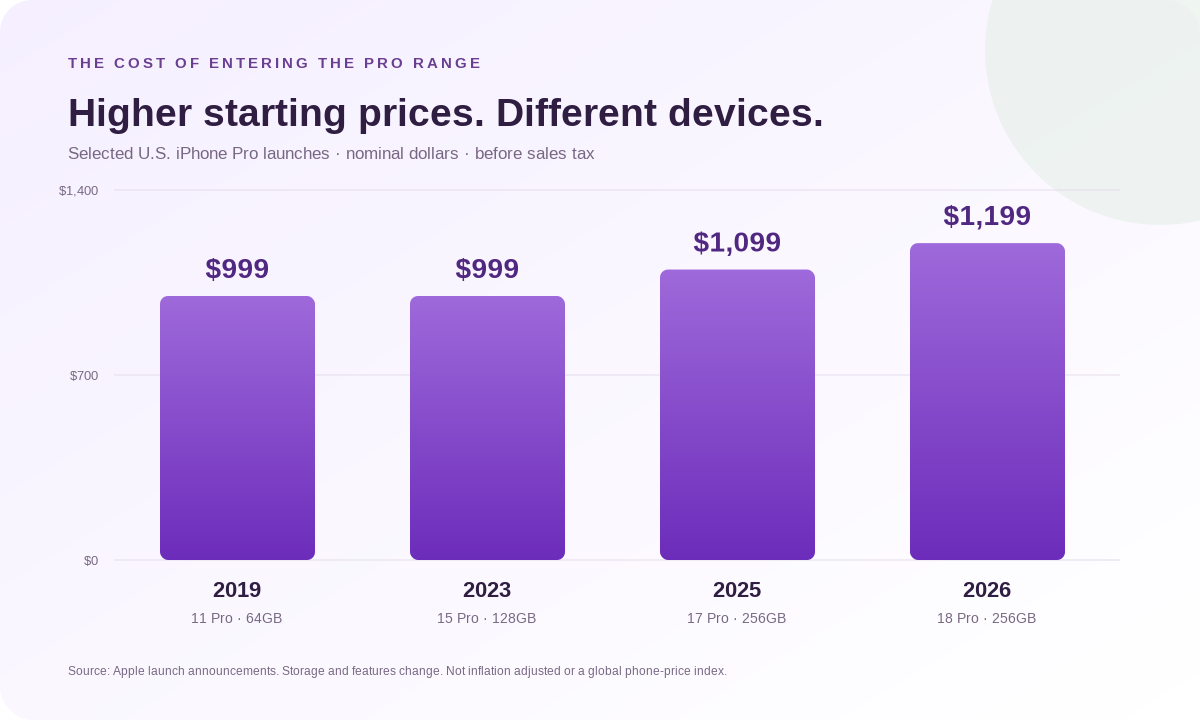
- Selected U.S. iPhone Pro starting prices rose from $999 in 2019 to $1,199 in 2026, alongside changes in storage and features.
- Component forecasts change: November’s newer NAND outlook revised the earlier growth projection downward.
- Apple’s U.S. 50GB, 200GB, and 2TB cloud rates match between its 2022 announcement and current pricing page.
- Your bill can still rise when a growing library pushes you into a larger plan. Cleanup may help when unwanted files are the reason.
What phone prices show over the years
The cost of entering a premium phone range can rise, even while the device itself changes. The chart below follows selected standard-size iPhone Pro models, using Apple’s published U.S. starting prices. It is an example of one product family, not an average for all phones or countries.
| Year | Model | Base storage | U.S. price | Source |
|---|---|---|---|---|
| 2019 | iPhone 11 Pro | 64GB | $999 | Apple launch announcement |
| 2023 | iPhone 15 Pro | 128GB | $999 | Apple launch announcement |
| 2025 | iPhone 17 Pro | 256GB | $1,099 | Apple launch announcement |
| 2026 | iPhone 18 Pro | 256GB | $1,199 | Apple launch announcement |
The nominal starting-price increase from these 2019 to 2026 examples is about 20.0%, calculated as ($1,199 − $999) ÷ $999. But entry storage increased from 64GB to 256GB. This is not a fixed-specification comparison, an inflation-adjusted index, or evidence that the price per gigabyte rose.
The 2025 and 2026 examples both start at 256GB, with prices of $1,099 and $1,199. That is about a 9.1% increase in the starting price, although the chip, cameras, and other features also differ. The flat $999 examples in 2019 and 2023 matter too: the history is not a straight upward line.
What is putting pressure on hardware prices?
Memory supply is one documented source of pressure, not a complete explanation of a phone’s retail price. A handset contains working memory, usually DRAM, and persistent storage, typically NAND flash. These are different from its main processor, but all are hardware choices a manufacturer must budget for.
In its September 30, 2026 memory-market outlook, TrendForce reported that suppliers were prioritizing advanced capacity for server products amid AI demand. It projected fourth-quarter contract-price rises, compared with the previous quarter, of 10% to 15% for conventional DRAM and 15% to 20% for NAND flash. Those figures are forecasts for component markets, not measured increases in every phone’s shelf price.
TrendForce’s November 6 update on smartphone memory sourcing describes budget-phone makers increasingly using lower-cost, reused memory components to contain production costs. This illustrates another response to cost pressure: manufacturers may change components rather than pass every increase directly to the buyer.
November 19 update: TrendForce’s newer NAND outlook reduced its fourth-quarter price-growth forecast to 8%–13% and projected a 0%–5% fall in the first quarter of 2027. This revises the earlier NAND outlook; it is still a component forecast, not a quote for a phone or cloud plan. Future prices remain uncertain.
Product design changes matter alongside input costs. The launch examples above offer different cameras, processors, and starting capacities. The cited evidence does not tell us how much of any individual Apple price change is attributable to memory, or establish that higher consumer cloud bills cause higher handset prices.
The cloud bill can grow without a price hike
Separate a higher rate from a move to a bigger plan. Apple’s January 2022 services announcement lists U.S. iCloud+ prices of $0.99 for 50GB, $2.99 for 200GB, and $9.99 for 2TB per month. Its current plans and pricing, checked November 21, 2026, lists the same U.S. amounts.
| Capacity | January 2022 | November 2026 check |
|---|---|---|
| 50GB | $0.99 | $0.99 |
| 200GB | $2.99 | $2.99 |
| 2TB | $9.99 | $9.99 |
These two snapshots do not reconstruct every intervening date, every market, or the value of all bundled features. They show why a blanket claim that all cloud storage prices keep rising would be misleading.
Yet a growing library can still change what you pay. At the current U.S. monthly rates, moving from 200GB to 2TB changes the bill by $7 a month, or $84 across twelve monthly payments. That is a plan change with more capacity, not inflation in the same plan. Rates, taxes, promotions, and billing arrangements may differ where you live.
Explore what a monthly storage bill adds up to
Choose a listed U.S. plan and a time period. This illustration holds the November 2026 monthly rate constant; it is not a prediction of future prices, a recommendation, or a claim about what you can save.
$143.52
48 monthly payments of $2.99 at a constant rate.
Formula: monthly rate × 12 × years. Excludes tax adjustments, discounts, future rate changes, and other purchases. Your selections stay in this page and are not saved or sent anywhere.
For a comparison using your own prices and the cost of a paid cleaner, use the cost calculator in our cleanup-before-upgrading guide.
Where a cleanup habit changes the story
Return to that crowded phone. Some files deserve more space: family videos, work documents, the pictures you would never want to lose. Others may be accidental duplicates or screenshots of a ticket from two years ago. Paying for more capacity without reviewing the difference means carrying both forward.
A cleaner app can make that review easier. Grouping similar images, surfacing screenshots, and offering video compression gives you a manageable place to start. The value is the decision it helps you make about your own media, not a promise that every scan produces a fixed amount of space.
Review what stays
Check duplicate and similar shots, screenshots, and recordings. Preserve important copies and confirm any deletion.
Measure the result
Check device storage again. If your blocked task works, you have addressed a specific capacity problem.
Reassess the bill
Check cloud usage separately. Only consider a smaller plan if it fits your needs, and include any cleaner charges.
Apple’s device-storage and iCloud guide makes the distinction clear: buying cloud space does not add physical capacity to the phone. Conversely, Google Photos’ Free up space on your device feature removes local copies of backed-up media while keeping the cloud library. A local cleanup does not automatically shrink a cloud subscription.
If you use iCloud Photos, Apple’s storage-management guidance explains that deleting synced media can remove it across connected devices. Verify separate copies of anything irreplaceable before reducing your library.
Why a cleaner can earn a place on your phone
For someone with a busy camera roll, cleanup can become a regular part of looking after a device they already paid for. Fast Cleaner helps group duplicate and similar photos, review screenshots, and compress videos, with suggestions you can inspect before confirming removal.
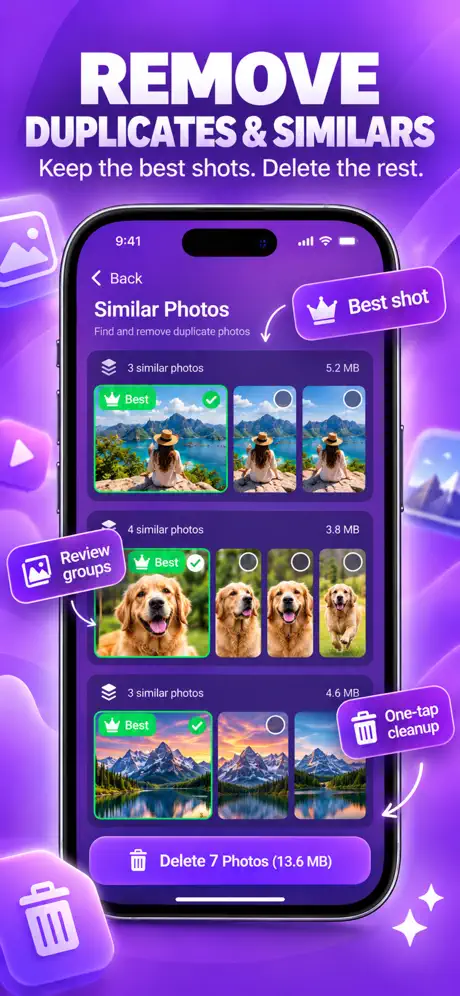 Review the lookalikes
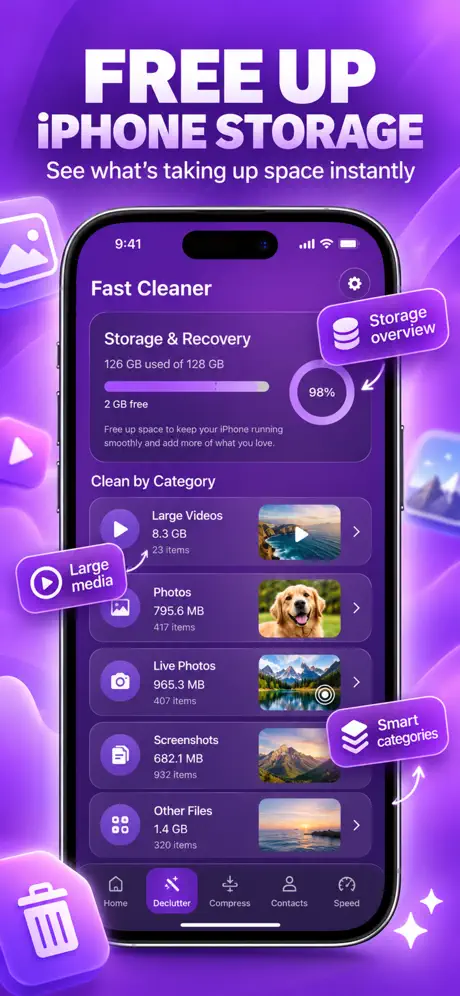 Find the next category
Our privacy policy describes on-device media analysis, with limited analytics and diagnostics handled separately. Read the policy and your platform’s current checkout terms before choosing a tool.
A dedicated cleaner is useful when its workflow helps you review more effectively than the tools you already have. Built-in cleanup or manual review may also meet your needs. What deserves a place in every storage decision is a review of what you are paying to keep.
Keeping a phone longer can defer a storage-driven purchase. It cannot add RAM, repair a battery, or extend software support. If essential content still exceeds capacity, compare archiving, cloud access, repair, or replacement. Our interactive next-step guide can help you organize those options.
Questions behind the headline
Are all phones and cloud plans becoming more expensive?
No. Prices depend on product, capacity, market, and date. The selected Pro launch examples show a higher starting price in 2026, while the U.S. cloud snapshots above show unchanged rates. Your own bill may rise because you choose more capacity.
Does AI make my cloud bill increase automatically?
No. The cited memory research concerns component supply and demand. It does not establish an automatic change to your consumer subscription. Check your provider’s actual pricing and renewal terms.
Is a cleaner a must-have app?
It can be a useful tool for a media-heavy phone, but it is not a requirement for every device. Start with what needs reviewing, compare built-in options, and choose a workflow whose features, data handling, and price fit you.
Can cleanup really save money?
It may help if unwanted content is pushing you toward spending you can avoid or postpone. A lower cloud bill requires an actual plan change, and any cleaner fees reduce the benefit. Measure your own result rather than assuming a fixed saving.
Keep the memories.
Review the clutter.
Explore Fast Cleaner’s on-device cleanup tools and decide what deserves space on your phone.
Product descriptions come from Fast Cleaner. Industry sources provide market context and do not endorse the app.
Compare media cleanup with cloud capacity
| Option | Changes | Cost question |
|---|---|---|
| Fast Cleaner | Helps review unwanted local media. | Android is free; iPhone has optional purchases. |
| An iCloud+ plan | Adds cloud storage and plan features. | Check recurring price and actual usage. |
| A separate local archive | Moves preserved copies to another storage location. | Include drive cost, backup upkeep and access needs. |
Apple’s wording:
you're billed monthly.
Apple describes iCloud+ billing this way. Recheck your country’s current plan and whether all stored data fits before changing tiers.
Platform source: Apple — iCloud+ plans and pricing, checked November 21, 2026.

Where Fast Cleaner fits
Treat Fast Cleaner as a media-review tool in the comparison, not a substitute for a backup service. Only describe a bill reduction after you have actually changed a plan and verified the new charge.
Fast Cleaner’s privacy policy describes on-device media analysis with separate limited analytics. Compare Android and iPhone pricing.
Continue with Can Fast Cleaner help me keep my current phone longer?.
Source check: November 21, 2026. Phone figures are selected nominal U.S. launch starting prices, before sales tax, trade-ins, and carrier offers. Cloud figures are U.S. monthly plan snapshots. Percentage changes and multi-year totals are our arithmetic from the linked prices. These are examples, not a global cost index or an estimate of app savings.